The Partygoer: Jesus Among the Tax Collectors and Sinners
You were in a place where they were talking and listening to music. Prayer welled up in your soul, bringing an unspeakable solace.
St. Josemaria Escriva
The Forge, no. 537
Jesus presents Himself under several poignant and sometimes surprising images in the Gospels: bread, gate, good shepherd, light, midnight thief, redeemer, bridegroom, savior, and Lord, among others. Do we risk irreverence in considering Jesus as partygoer? Jesus is certainly willing to risk His reputation by banqueting with “tax collectors and sinners,” so maybe we aren’t too far off.
Banquets recur throughout His parables. Jesus is the late-returning “master [coming] home from the marriage feast” who might well return at any hour past midnight to reveal your readiness (see Lk 12:35-40). He is the tardy bridegroom, whose lateness tests the vigilance of the 10 virgins, “and those who were ready went in with him to the marriage feast; then the door was locked” (see Mt 25:1-13). Some of the symbolic, parabolic feasts undergo a swift scene-change, becoming courtrooms where attendees are judged based on their preparedness to be there, in proper attire and on time. The New Testament all but concludes with a blessing on “those who are invited to the marriage supper of the Lamb” (Rev. 19:9). Clearly the banquet or feast is more than a venue for merrymaking. It is an eternal and final destination.
Jesus attended dinner parties and banquets frequently enough that His adversaries caricatured Him as “a glutton and a drunkard, a friend of tax collectors and sinners” (Mt 11:19)! Yes, the gatherings attended by Jesus were culturally different from those we attend in the western world in the 21st century, but not completely dissimilar. Of course, there have always been organized occasions of debauchery like Herod’s infamous birthday party, but so have there always been the tamer variety: a gathering of family and friends, table fellowship, music, conversation, maybe dancing.
The party thrown by Levi/Matthew, however, was highly unusual. You can imagine his fellow “tax collectors and sinners” dressed in richly textured clothing, necks hung thick with jeweled chains and pendants, exuding perfumes, scented oils. Warm food is served on low tables surrounded by cushions; flat breads are coming continually out of a hot oven. Franco Zeffirelli’s 1977 miniseries Jesus of Nazareth might be the finest cinematic depiction to date of the crowded, sensual atmosphere of Matthew’s house—in which setting Zeffirelli very creatively and affectingly has Jesus tell the Parable of the Prodigal Son—to an audience of tax collectors and sinners.
So far, none of these features make this party unusual. What changes everything is the presence of Jesus. In a setting where a holy man normally would never be invited nor feel welcomed, He comes.
And so do you. Your friend Matt has invited you. You arrive and begin to mingle with everyone. You seat yourself comfortably amid food and drink and music and smoke and perfumes and all kinds of loud and foolish talk. You are chatting with friends, laughing, having drinks. Within your soul, you’re not entirely at peace. But that’s normal for you. You live with it, and don’t know what to do with it. But on the other hand, neither does anyone else. It’s the unspoken kinship that bonds you with the others. The drinking, music, and laughter is the protocol, the accepted etiquette, that numbs it for an evening.
But then, from across the crowded room, you notice… Him. He gets your attention not by how He is dressed but by how He is not: nothing fine, costly, or showy, but certainly dignified. He stands out but also fits in so naturally. He interacts with everyone, with ease, cheerfulness, and sincere interest in each. He commands attention, but is not boisterous, does not shout. He lacks the stereotypical “Long face, rough manner, ridiculous appearance, [and] unfriendly attitude” that many people might associate with a holy man (The Way, no. 661). He seems in control of the room yet is so unassuming. The room is hung with oil lamps, yet He quenches not a single wick as He passes by.
Your lack of inner peace spikes up again, even after wine, but you also sense a previously unknown hope surging within you and drawing you to the Stranger across the room. Something like prayer wells up within you. You approach. He turns to you, with delight. And you take up the story from there.
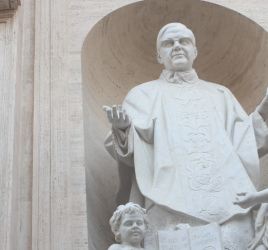
Jesus will go anywhere to find us. He leaves the 99 sheep to rescue the one wherever it might be stuck. St Josemaría once sought and received permission to minister to a dying man in a brothel—the brother of one of the prostitutes. His only condition was that on the day when he brought the Blessed Sacrament to the man there would be nothing offensive to God going on in the house. [1] In a more ancient setting, Abba St John (surnamed “the Dwarf”), a 4th-century monk of the Egyptian desert, once visited a brothel to confront Paesia (subsequently St Paesia) for having fallen away from her former devotion to the Lord. Sitting on her bed, he jolted her back into reality with: “What have you got against Jesus that you behave like this?” [2] So iconic is this story that St Therese of Lisieux prominently features it in The Story of a Soul [3] as an illustration of how God’s mercy and the soul’s love for Him can conspire to accelerate conversion, even in the most unlikely circumstances.
Whether we reference saints ancient or modern, it is the Lord’s bad example they are following, as they unhesitatingly rush in where some timid angels might fear to tread, but not the ones who continually see the face of the Father and who ascend and descend upon the Son of Man. No, they know how He operates. They are the ones who feast and rejoice with Him “more” over the one retrieved sheep than over the ninety-nine that never strayed (see Mt 18:13; Lk 15:10). They clear the way for Him and for the saints. They open eyes, ears, and hearts of prodigal children in the strangest of places—like the archetypal place of filth, the pigsty, over which the famous runaway remembered his father’s house.
The story of Matthew’s party is forever enshrined in Scripture so that our story may not conclude prematurely in loss. When we might not entertain hope, or see a way out, sometimes in a place where people are chatting, and listening to music, you might encounter a fellow partygoer who has some good news for you. “You look a little unwell,” He says. “But don’t worry. For the sick I have come.”
[1] Andrés Vázquez de Prada, The Founder of Opus Dei, vol. 1 (New York: Scepter, 2003), pp. 318-19.
[2] Benedicta Ward, Harlots of the Desert (Kalamazoo: Cistercian Publications, 1987), pp. 77-78.
[3] St. Therese of Lisieux, The Story of a Soul, tr. J. Clarke, OCD (Washington, D.C.: Institute of Carmelite Studies, 1996), p. 259.
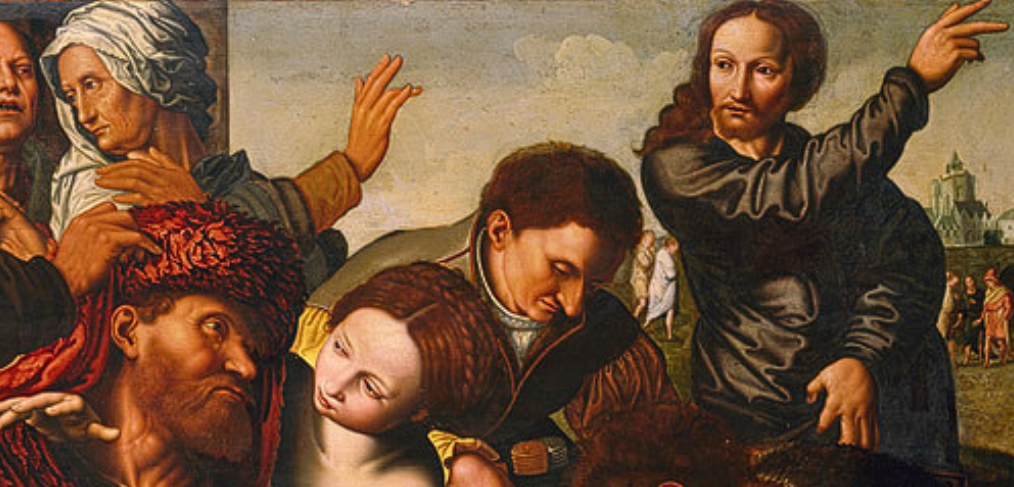
Cover Image: Jesus Summons Matthew to Leave the Tax Office (1540) by Jan van Hemessen (WikiArt)
 Rev. John Henry Hanson, O. Praem.
Father John Henry Hanson, O. Praem., is a Norbertine priest of St Michael’s Abbey in Silverado, California. He earned his STB and Masters in Theology at the Pontifical University of St Thomas (Angelicum) in Rome, and was ordained to the priesthood in 2006. He holds a Masters in Psychology from Divine Mercy University, is a formator in his community's seminary, and serves Armenian Catholics at the Cathedral of St Gregory the Illuminator in Glendale, California. He is author of several books, including Praying from the Depths of the Psalms, Coached by Josemaría Escrivá, and his upcoming The Fire and the Silence: Prayer, Thought, and the Battle for Inner Stillness. He and his community are cooperators of Opus Dei.