“Women in Social Life and in the Life of the Church” | Conversations with St. Josemaria Escriva
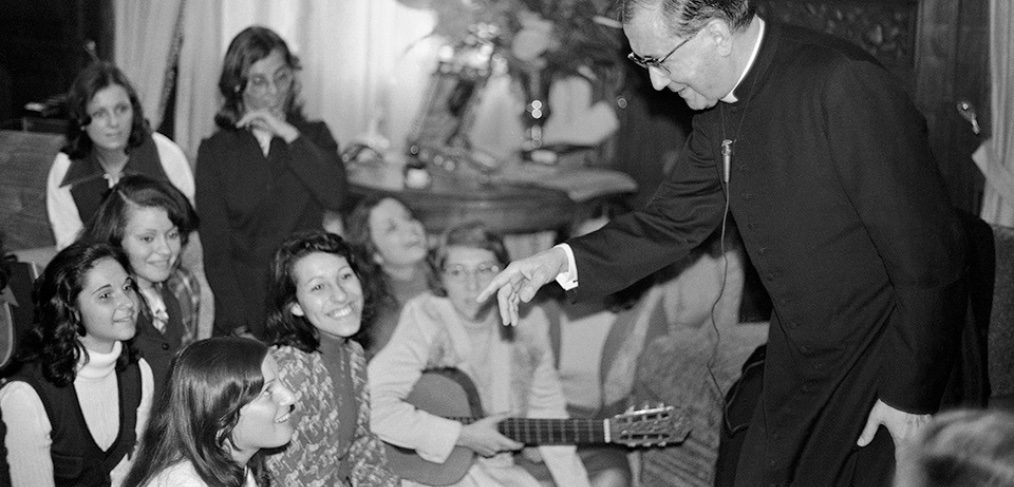
In 1967, Pilar Saucedo of Telva – a women’s magazine published in Madrid, Spain – interviewed St. Josemaria Escriva on the role of women in the family, society, and the Church. Following is the published interview.
Monsignor, the presence of women in social life is extending far beyond the sphere of the family, in which they have moved almost exclusively up to now. What do you think about this development? What, in your opinion, are the main characteristics that women have to develop if they are to fulfill their mission?
Firstly, let me say that I do not think there need be any conflict between one’s family life and social life. Just as in a man’s life, but with particular shades of difference, the home and the family will always occupy a central place in the life of a woman. For it is obvious that when she spends time on her family she is fulfilling a great human and Christian role. Nevertheless, this does not exclude the possibility of her having other professional work — for housework is also professional work — in any worthwhile employment available in the society in which she lives. I can understand why you state the problem the way you do. But I think that if we systematically contrast work in the home with outside work, retaining the old dichotomy which was formerly used to maintain that a woman’s place was in the home but switching the stress, it could easily lead, from the social point of view, to a greater mistake than that which we are trying to correct because it would be more serious if it led women to give up their work in the home.
Even on the personal level one cannot flatly affirm that a woman has to achieve her perfection only outside the home, as if time spent on her family were time stolen from the development of her personality. The home — whatever its characteristics, because a single woman should also have a home — is a particularly suitable place for the growth of her personality. The attention she gives to her family will always be a woman’s greatest dignity. In the care she takes of her husband and children or, to put it in more general terms, in her work of creating a warm and formative atmosphere around her, a woman fulfills the most indispensable part of her mission. And so it follows that she can achieve her personal perfection there.
What I have just said does not go against her participating in other aspects of social life including politics. In these spheres, too, women can offer a valuable personal contribution, without neglecting their special feminine qualities. They will do this to the extent to which they are humanly and professionally equipped. Both family and society clearly need this special contribution, which is in no way secondary to that of men.
Development, maturity, emancipation of women should not mean a pretense of equality, of uniformity with men, a servile imitation of a man’s way of doing things. That would not get us anywhere. Women would turn out losers, not because they are better than men or worse, but because they are different.
In terms of fundamentals, one can in fact speak of equal rights which should be legally recognized, both in civil and ecclesiastical law. Women, like men, possess the dignity of being persons and children of God. Nevertheless, on this basis of fundamental equality, each must achieve what is proper to him or her. In this sense a woman’s emancipation means that she should have a real possibility of developing her own potentialities to the fullest extent — those which she has personally and those which she has in common with other women. Equal rights and equal opportunities before the law do not suppress this diversity, which enriches all mankind. They presuppose and encourage it.
Women are called to bring to the family, to society and to the Church, characteristics which are their own and which they alone can give: their gentle warmth and untiring generosity, their love for detail, their quick-wittedness and intuition, their simple and deep piety, their constancy… A woman’s femininity is genuine only if she is aware of the beauty of this contribution for which there is no substitute and if she incorporates it into her own life.
To fulfill this mission, a woman has to develop her own personality and not let herself be carried away by a naive desire to imitate, which, as a rule, would tend to put her in an inferior position and leave her unique qualities unfulfilled. If she is a mature person, with a character and mind of her own, she will indeed accomplish the mission to which she feels called, whatever it may be. Her life and work will be really constructive, fruitful and full of meaning, whether she spends the day dedicated to her husband and children or whether, having given up the idea of marriage for a noble reason, she has given herself fully to other tasks.
Each woman in her own sphere of life, if she is faithful to her divine and human vocation can and, in fact, does achieve the fullness of her feminine personality. Let us remember that Mary, Mother of God and Mother of men, is not only a model but also a proof of the transcendental value of an apparently unimportant life.
At times, however, a woman is not sure of having found the place which suits her and to which she is called. Often, if she has a job outside, the demands of the home weigh her down and if she spends all her time with her family, she feels that her scope is being limited. What would you say to women who have this experience?
This very real feeling is frequently due to particular limitations which we all have because we are human: it comes because we lack well-determined ideals capable of guiding our whole life, or because of a subconscious pride. At times, we would like to be outstanding in everything. And since this is impossible, it leads to confusion and anxiety, or even depression and boredom: you cannot do ten things at the same time, you do not know which to do, and you end up doing nothing well. In this situation, jealousy can develop, one’s imagination easily becomes escapist and seeks refuge in fantasy which, leaving reality far behind, ends up weakening one’s will-power. It is what I have repeatedly called ‘mystical wishful thinking’, made up of useless day dreams and empty ideals: If only I hadn’t married, if only I did not have this job, if only I had better health, or was younger, or had more time!
Like everything valuable the solution is costly. It lies in the search for the true centre of human life, which can give priority, order and meaning to everything. We find this centre in our relations with God by means of a genuine interior life. By making Christ the centre of our lives, we discover the meaning of the mission he has entrusted to us. We have a human ideal that becomes divine. New horizons of hope open up in our life and we come to the point of sacrificing willingly, not just this or that aspect of our activity, but our whole life, thus giving it, paradoxically, its deepest fulfillment.
The problem you pose is not confined to women. At some time or other, many men experience the same sort of thing with slightly different characteristics. The source of the trouble is usually the same lack of a high ideal that can only be discovered with God’s light.
But smaller remedies, which seem trivial, must also be used. When there are lots of things to do you have to establish priorities, to get organized. Many difficulties stem from downright disorder. There are women who do hundreds of things and all of them well because they are well organized and have courageously imposed order on all their work. They know how to concentrate at each moment on what they have to do, without getting worried about what is round the corner, or what they might have been able to do before. Others are overwhelmed by all that there is to do, and because they are overwhelmed, they do nothing.
Certainly there will always be many women whose only task is to run their home. This is a wonderful job which is very worthwhile. Through this profession — because it is a profession, in a true and noble sense — they are an influence for good, not only in their family, but also among their many friends and acquaintances, among people with whom they come in contact, in one way or another. Sometimes their impact is much greater than that of other professional people, to say nothing of when they put their experience and knowledge at the service of hundreds of people in centers devoted to the formation and education of women, like those which my daughters in Opus Dei direct all over the world. Then they teach others to run a home, and become educators who are more effective, I would say, than many university professors.
Please excuse me for insisting on the same subject. Through the letters which reach our Editor’s desk, we know that some mothers of large families complain about their being limited to the role of having children, and feel dissatisfied about not being able to devote their life to other fields: professional work, cultural activities, social work… What advice would you give them?
Now just a moment! What is social work, if not giving oneself to others, with a sense of dedication and service and contributing effectively to the good of all? The job of a woman in her house is a social contribution in itself and can easily be the most effective of all.
Take the case of a large family. The mother’s work is comparable to that of professional teachers and in many cases leaves them in the shade. A teacher manages to educate a number of boys and girls more or less successfully in the course of his life. A mother can give her children a solid set of values and shape their character, and can make them, in their turn, other teachers, thus setting up an uninterrupted chain of responsibility and virtue.
In these matters it is easy to be misled by mere numbers and to think that the work of a teacher, who sees hundreds of people pass through his classes, or that of a writer who reaches thousands of readers, is more valuable. That is all very well, but how many people are really formed by that teacher or writer? A mother has three, five, ten or more children in her care and she can make of them a true work of art, a marvel of education, of balance and understanding, a model of the Christian way of life. She can teach them to be happy and to make themselves really useful to those around them.
Besides, it is natural for the children to help with the household chores; and a mother who knows how to bring up her children well can manage this. This way she will have spare time which, if used well, will enable her to cultivate her personal interests and talents and to enrich her culture. Fortunately, these days there is plenty of technical equipment, household appliances and that sort of thing, which can be great time-savers if full advantage is taken of them and they are used correctly. As in every field, personal qualities are what count. Some women with the latest-model washing machine take longer to do the washing, (and do it worse) than when they did it by hand. Appliances are useful only when one knows how to use them.
I know of many married women with large families who manage their home very well and still find time to cooperate in other apostolic tasks, just like that early Christian married couple, Aquilla and Priscilla. They worked in their house and at their job, and besides this were splendid cooperators of St. Paul. With their word and example they brought Apollo to the Faith of Jesus Christ, a man who was later to become a great preacher of the early Church. As I have already said, someone who really wants to, can overcome quite a number of limitations, without neglecting any of his duties. In fact, there is time for a lot of things: for running a home with professional outlook, for giving oneself continually to others, for improving one’s own culture and for enriching that of others, and for carrying out many other effective tasks.
You refer to the presence of women in public life, in politics. What do you consider the specific task of women in this field?
The presence of women in the whole range of social life is a logical and entirely positive phenomenon, part of the broader phenomenon to which I referred earlier. A modern democratic society has to recognize women’s right to take an active part in political life and it has to create conditions favorable for everyone who wants to exercise this right.
A woman who wants to play an active role in public affairs has an obligation to prepare herself adequately, so that the part that she takes in the life of the community can be responsible and positive. All professional work demands previous training and a constant effort to improve one’s formation and to adapt it to the new circumstances that may arise. And this is very specially true for those who aspire to occupy leading positions in society, because they are called to a very important service on which the entire community’s well-being depends.
A woman with adequate training should find the field of public life open to her at all levels. In this sense it is impossible to point out specific tasks that correspond to women alone. As I said earlier, in this field what is specific is not the task or position in itself, but the way in which the work is done. There are values which a woman more readily perceives, and her specific contribution will often, therefore, change the whole approach to a problem, and can lead to the discovery of completely new approaches.
By virtue of their special gifts, women greatly enrich civil life. This is very obvious, for example, in the sphere of family or social legislation. Feminine qualities offer the best guarantee that genuine human and Christian values will be respected when it comes to taking measures that affect family life, education. and the future of youth.
I have just mentioned the importance of Christian values in the solution of social and family problems, and I want to stress their particular importance in all public life. Just as for a man, when a woman takes part in political activity, her Christian Faith confers on her the responsibility of carrying out a genuine apostolate, that is to say, a Christian service to the whole of society. This does not mean representing the Church officially or semi-officially in public life, and even less using the Church for your own personal career or for party interests. On the contrary, it means forming your own opinions with freedom in all those temporal matters in which Christians are free, and accepting personal responsibility for your opinions and actions, which should be always in keeping with the Faith you profess.
“Women in Social Life and in the Life of the Church” is an interview with St. Josemaria Escriva by Pilar Saucedo of Telva – a women’s magazine published in Madrid, Spain. The full interview is published in the book Conversations with Saint Josemaria Escriva, available from Scepter Publishers.
 St. Josemaria Institute
The St. Josemaria Institute was founded in 2006 to promote the life, teachings, and devotion to St. Josemaria Escriva among all men and women who desire to find meaning and happiness in their daily lives by growing closer to God. The St. Josemaria Institute produces and distributes digital and print media as a means to spread Christian values around the world and to help people navigate and live well in the digital age.