“Sanctifying the Family Table” | Contemplatives in the Middle of the World
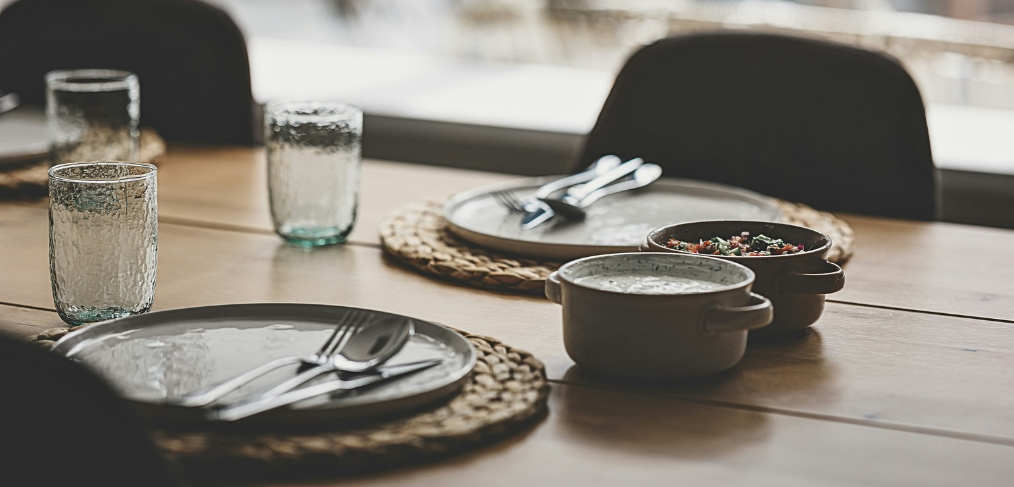
This year we are trying to focus more on contemplation, how to be contemplatives in the middle of the world. Another way of putting this is that we want to open our eyes more to God’s presence and action in our lives, in the world, in ordinary, everyday things. As Msgr. Fernando Ocariz, for us the Father, writes in his recent pastoral letter: “Faith opens our eyes to perceive God’s ever-active presence here and now” (Letter 16-X-26, n. 10). And it occurred to me that there is one important place or context in our lives – which plays a big part in our lives, which we turn to on various moments of our day – that I, at least, have never consciously prayed about, and I guess that most of you haven’t prayed about either. And that seemed to me a big – even a surprising – omission which I want to put right today. I wonder if you can guess what I have in mind. I am speaking of the dinner table, the table, the space, where we come together as a family to eat. How can we be more contemplatives at the dinner table? Have we even thought about being contemplatives at the dinner table, going to a meal in and with God, with the eyes of faith? Opus Dei is about sanctifying all ordinary realities. Surely, we should also sanctify the dinner table, the family meal, particularly as it has such a frequent and important role in our lives and our family life. It is so much a part of our ordinary life.
SEEING WITH THE EYES OF GOD
Parents sometimes tell their children – when a child has taken more than he or she can eat – that their eyes were bigger than their stomach. The point is that the child saw the food with eyes of physical desire, their craving, their desire to eat that food, but then in fact they couldn’t eat so much. Well, we don’t just want eyes of physical craving, we want to see with the eyes of Christ. We want to say to Our Lord, also at meal-times, these words of our Father, St. Josemaria: “Lord, let me see with your eyes, my Christ, dear Jesus.” Yes, may I not see with the eyes of my stomach, of physical craving, but with your eyes, Jesus: the eyes of love, love of God and love of others, eyes able to appreciate God’s glory and to glorify him in what I eat.
OUR LORD AT THE DINNER TABLE
Jesus, how would you have seen food? How would food and meals have been part of your work of redemption? We certainly see you often at table, or – strictly speaking – reclining on the floor together with others, with the food in the centre, as this was the usual way to eat then. For example, “When one of those who sat at table [reclined] with him heard this, he said to him, ‘Blessed is he who shall eat bread in the kingdom of God!’” (Lk 14:15). “And as he sat at table in the house, behold, many tax collectors and sinners came and sat down with Jesus and his disciples” (Mt 9:10). And two of the greatest moments of Our Lord’s life are around a dinner table (or reclining around food). At the wedding feast in Cana, which was of course also a meal, Jesus does his first miracle and so, together with the Baptism at the Jordan, inaugurates his public mission, leading the disciples to believe in him more. And he begins to bring his mission to a close at the Last Supper, at a meal: “When it was evening, he sat at table with the twelve disciples” (Mt 26:20). And in Luke, Our Lord says: “I have earnestly desired [with desire have I desired: Desiderio desideravi] to eat this passover with you before I suffer; for I tell you I shall not eat it until it is fulfilled in the kingdom of God’” (Lk 2:15).
A FORETASTE OF THE HEAVENLY BANQUET
Jesus, we are called to share in your work of redemption and we also have to do so at meal-times and through meals. We are even told that the end of time, the final state of the Church, its eschatological end, will be a meal, a wedding feast: “Blessed are those who are invited to the marriage supper of the Lamb!” (Rev 19:9). Various Old Testament texts also describe the end of time of as an eternal banquet, for example Isaiah 25:6: “On this mountain the Lord of hosts will make for all peoples a feast of fat things, a feast of wine on the lees, of fat things full of marrow, of wine on the lees well refined.” If we are to share in that feast, that banquet, we somehow have to prepare ourselves on earth. We do that most of all by sharing at the table of the Eucharist, but also to a lesser extent by sharing in ordinary meals in and for God. We need to make every meal in some way at least a foretaste, a prefiguring of the heavenly banquet.
Cover image via Unsplash
 Fr. Joseph Evans
 is a Catholic priest and a member of Opus Dei. He has worked as a journalist and youth worker, and is currently a university chaplain in Oxford, England. He is co-founder and Editorial Director of Adamah Media and a poet. His most recent work, “When God Hides”, was published by SLG Press. "Into the Deep" is a podcast by Fr. Joe designed for both men and women to facilitate a profound, personal encounter with the living presence of Jesus Christ. Tune in on Apple Podcast, Spotify, or your favorite listening app.